

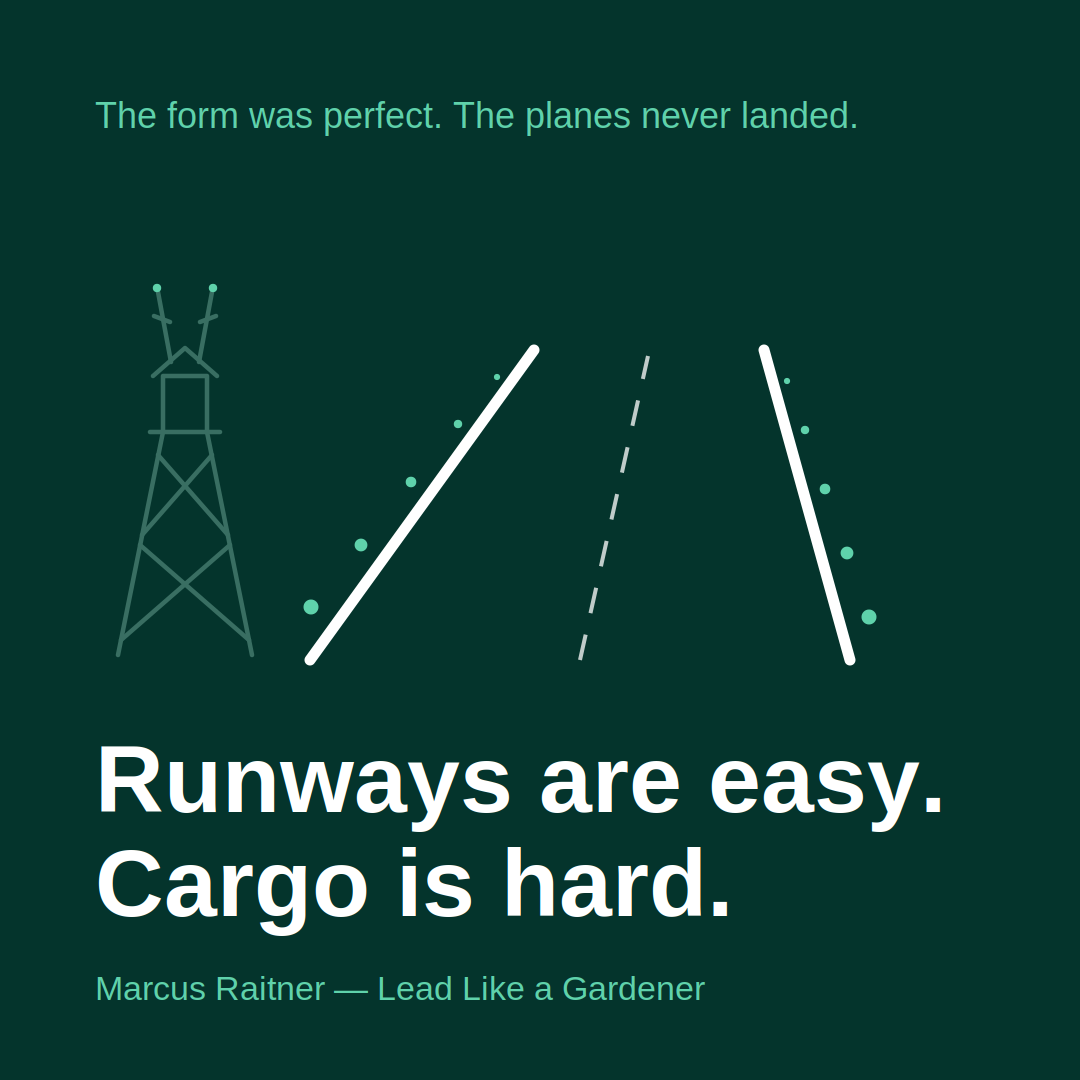
After the Second World War, something strange happened on the islands of Melanesia. During the war, the islanders had watched military planes land with cargo — food, tools, medicine, wealth beyond anything they had known. Then the war ended, the bases closed, and the planes stopped coming. So the islanders did what any reasonable observer might: they rebuilt what they had seen with what they had. Runways cleared by hand. Control towers of bamboo. Wooden headsets worn by men sitting where the controllers used to sit. The form was perfect, down to the details.
The planes never landed.
Anthropologists gave the pattern its name in the 1940s: cargo cult. The physicist and Nobel laureate Richard Feynman carried the term out of the South Pacific in his famous 1974 Caltech commencement address, coining cargo cult science for research that follows every form and precept of scientific investigation — apparatus, method, vocabulary, all impeccable — and yet the planes don’t land: no reliable knowledge emerges, because the one essential thing is missing. For Feynman, that essential thing was a radical honesty about one’s own results: “you must not fool yourself — and you are the easiest person to fool.” But the pattern is not confined to science. Organizations fall for it with remarkable regularity.
We saw it with Lean Management, then we saw it with Agile. There was a time when executives made pilgrimages to Spotify and Silicon Valley and came back with what they had seen: beanbags, foosball tables, sneakers, sticky notes, daily stand-ups. The Spotify model was copied by companies around the world — more faithfully, ironically, than Spotify itself ever practiced it. SAFe was rolled out like a new ERP system. And after a few years, across industries, came the hungover awakening: organizations that were perfectly agile on paper, with all the ceremonies and all the roles, and nothing had actually changed. Decisions still piled up at the same bottlenecks. Silos still stood, the handovers between them now called backlogs.
The mistake was never the methods. The mistake was confusing correlation with causation. Successful agile companies have stand-ups, cross-functional teams, and visible boards — but they are not successful because of these artifacts. The artifacts are the consequence of something deeper: a different way of thinking about customers, flow, and decision-making. Copy the consequence without the cause, and you get the bamboo control tower. The form is perfect. The planes don’t land.
Now we are witnessing the next wave unfold in real time. Companies are bolting AI onto unchanged processes — a digital colleague with a name and a job title, but the work around it untouched. Automation as ornament. The technology is new; the pattern is not. An AI agent inside a broken process is a faster broken process. Or, as the first part of this series put it: doing the wrong thing righter.
To be fair, none of these tools deserve the blame. Scrum works. SAFe has its place. AI agents are genuinely powerful. The reason copying them fails lies deeper — in a law of systems theory. John Gall practiced as a pediatrician in Ann Arbor for over forty years, but he became internationally known for his contributions to systems thinking. His 1975 book Systemantics contains the law that now bears his name:
“A complex system that works is invariably found to have evolved from a simple system that worked. A complex system designed from scratch never works and cannot be patched up to make it work.”
— John Gall (Systemantics, 1975)
His consequence: you have to start over with a simple system that works. An organization is such a complex system — a social one. A transformation that installs a target operating model as a blueprint, rolled out from glossy slides, is an attempt to design a complex system from scratch; Gall’s law predicts the outcome. Whatever works at Spotify was never designed upfront and rolled out in a transformation program — it evolved, step by step, from teams solving real problems together. Frameworks are not introduced, implemented, or imposed. They emerge. And that is why the artifacts cannot be copied: you can transplant the ceremonies, but not the history of shared problem-solving that produced them.
With AI transformation, this is doubly true. Agile at least offered seemingly proven blueprints to copy; for AI there are none yet. The possibilities are vast, the field is young, and everyone — including the most celebrated public examples — is still experimenting. Whoever copies an “AI operating model” today copies a running experiment. The way that does work is slower and less photogenic — think big, start small, learn fast — purposefully growing the system from simple to complex.
So the next time a transformation is presented to you as a set of visible things — ceremonies, roles, tools, agents — ask the cargo cult question: is this really the cause of success, or merely its silhouette?
Runways are easy. Cargo is hard.
Part 2 of the series “Empowering Transformation — Notes on Change That Sticks”. Part 1: “Doing the Wrong Thing Righter”. Next: what a 130-year-old story about electric motors teaches us about AI.
Sources and further reading: Richard Feynman, “Cargo Cult Science”, Caltech commencement address, 1974 — his own summary of the islanders is hard to beat: “They’re doing everything right. The form is perfect.” John Gall, Systemantics: How Systems Work and Especially How They Fail, 1975. This essay builds on two earlier pieces I wrote in German: “Die agilen Falschmünzer auf dem Weg in die Cargo-Kult-Hölle” (2019) and “Verkatertes Erwachen auf dem agilen Partyschiff” (2025).