

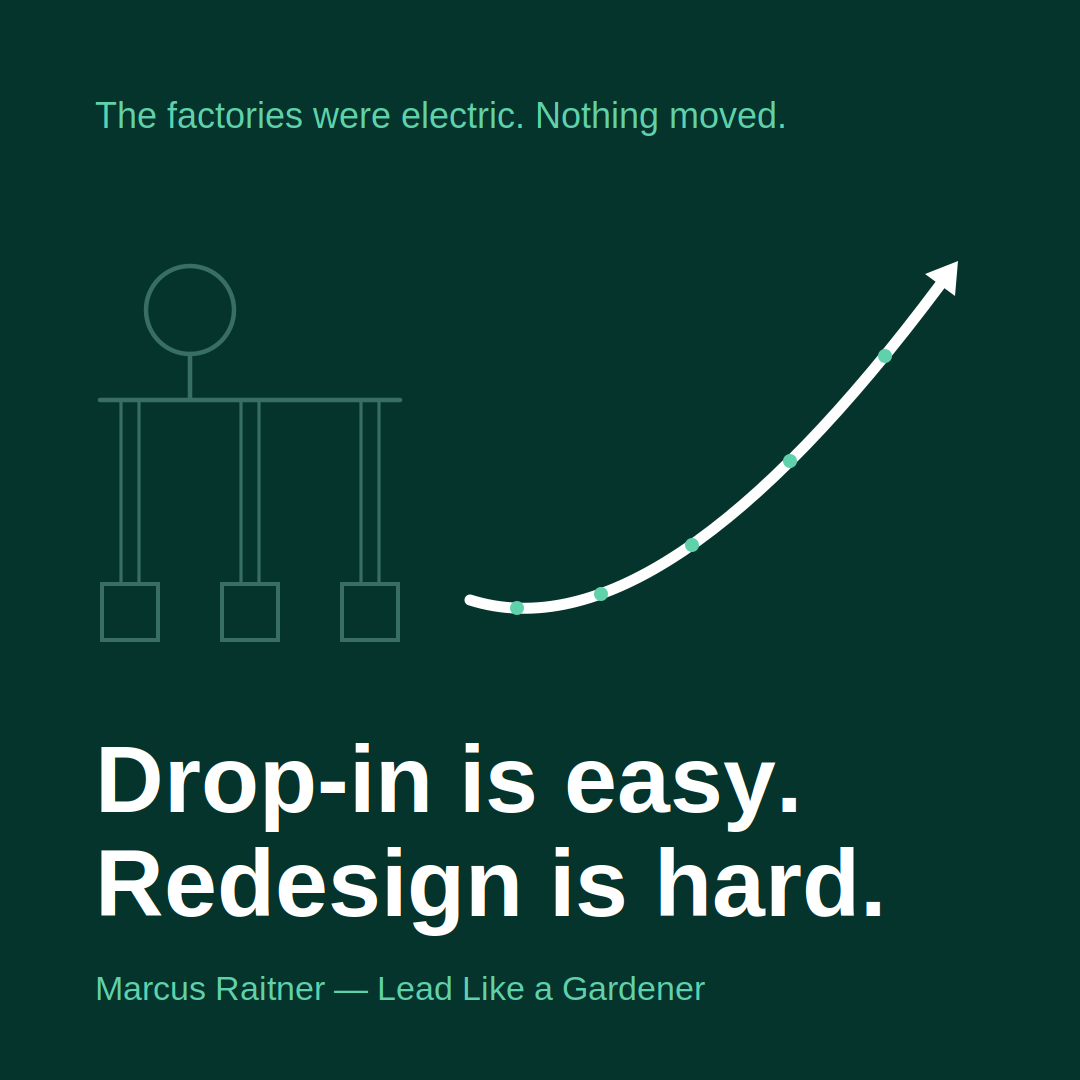
Picture a factory around 1890. In the basement sits a steam engine, the single source of power for everything above. Its force travels through the building along rotating line shafts, over belts and pulleys, up through the floors. The whole architecture serves the transmission of power: machines crowd as close to the shaft as possible, buildings grow tall and narrow around it, and when the engine stops — for maintenance, or because one belt snaps — the entire factory stops with it.
Then came the electric motor, and the engineers did the obvious thing: they threw out the steam engine and put one big electric motor in its place. A clean, sensible swap. No boiler, no coal, no smoke.
And then, for decades, almost nothing happened.
The factories were electric, but the productivity statistics barely moved. The shafts still turned, the belts still ran, the buildings still stood tall and narrow around a single source of power — now electric instead of steam, but the same system in every other respect. If this sounds familiar, it should. In 1987, the economist Robert Solow looked at two decades of computerization and quipped:
“You can see the computer age everywhere but in the productivity statistics.”
— Robert Solow, 1987
Three years later, the Stanford economic historian Paul David answered him with precisely this story. In “The Dynamo and the Computer” he showed that the productivity leap from electrification arrived only in the 1920s — roughly four decades after the first electric factories. Not because the technology was immature, but because the thinking was stuck in an unquestioned paradigm: as long as electricity was used to imitate steam, it could only ever be a slightly better steam engine.
The breakthrough came when engineers grasped what was genuinely new about electricity. Steam power is monolithic: one engine, one shaft, everything attached to it. Electric power is divisible: it can be split into any portion and delivered anywhere a wire reaches. So they stopped building one big motor and started putting a small motor on every machine. And that changed everything else. Factories no longer had to be built around a shaft; they could be built around the work. Single-story buildings, machines arranged along the flow of material, the assembly line — the productivity leap came from the redesign, not from the motor.
Which brings us to today. AI is being dropped into organizations exactly the way that first electric motor was dropped into factories: as a one-for-one replacement inside an unchanged system. An agent takes over a process step nobody has questioned. A copilot accelerates a workflow that should not exist in its current form — doing the wrong thing righter, as the first part of this series put it. The result is predictable, and some early adopters are already living it: better, not good.
To be fair, the drop-in phase is not stupidity — it is how every general-purpose technology starts, and the factories went through it too. It becomes a fallacy only when we mistake the first step for the destination, and then blame the technology for productivity gains that fail to appear. The technology is not the bottleneck. The unchanged system around it is.
The real question is the 1920s question: what is the unit drive of AI? And the honest answer is that nobody knows yet. Electricity’s decisive properties were anything but obvious in 1890 — that it was far easier to distribute than coal, and that it made small motors economical enough to put one on every machine, had to be discovered through decades of tinkering, not declared on a drawing board. What AI’s equivalent properties are — what it makes possible that was genuinely impossible before — is precisely what we still have to find out. That is why the slow route this series keeps arriving at is not caution but method: understand the system, fix it, then automate — and grow the new form through experiments instead of installing a blueprint that does not exist.
The invention was never the breakthrough. The redesign was.
Sources and further reading: Paul A. David, "The Dynamo and the Computer: An Historical Perspective on the Modern Productivity Paradox", American Economic Review 80(2), 1990. Robert M. Solow, "We'd Better Watch Out," New York Times Book Review, July 12, 1987, p. 36. This essay builds on an earlier piece I wrote in German: "Der Elektromotor und die Agilität" (2021).
Part 3 of the series “Empowering Transformation — Notes on Change That Sticks”. Find the previous parts linked below. Next: two companies, one technology, opposite outcomes — what IKEA and Klarna teach us about people and AI.
Doing the Wrong Thing Righter

Every large organization has lived through this project at least once. The automation initiative delivers on time and on budget. The dashboard turns green, the steering committee applauds, the case study is written. And a year later, nothing has actually changed: the customers are no happier, the backlog is no shorter, the people are no less busy. The p…
The Planes Never Landed

After the Second World War, something strange happened on the islands of Melanesia. During the war, the islanders had watched military planes land with cargo — food, tools, medicine, wealth beyond anything they had known. Then the war ended, the bases closed, and the planes stopped coming. So the islanders did what any reasonable observer might: they re…