

In February 2024, Klarna made the loudest AI announcement of the year. Its new assistant, built on OpenAI’s models, had handled 2.3 million customer conversations in its first month — two-thirds of all service chats — and was doing the work of roughly 700 full-time agents, projected to add 40 million dollars a year in profit. The company had already frozen hiring; attrition would eventually shrink the workforce from roughly 5,000 toward 3,000. For a while, this was the reference case: proof that AI could simply replace customer service.
Fifteen months later, Klarna changed course.
In May 2025, CEO Sebastian Siemiatkowski told Bloomberg that cost had become “a too predominant evaluation factor” in the AI rollout — and that “what you end up having is lower quality.” Klarna began hiring humans again, starting with a small remote pilot, and promised that “there will always be a human if you want.” By 2026, the company had settled on a hybrid model. The technology had worked exactly as advertised. The target it optimized for had not.
Now rewind three years, to a quieter story. In 2021, IKEA’s parent company Ingka Group launched a chatbot called Billie. By 2023, Billie had resolved 3.2 million customer conversations on its own — 47 percent of all inquiries, and about 13 million euros in saved handling costs. Which put IKEA at the same fork in the road Klarna would reach later: 8,500 call-center jobs technically redundant.
IKEA asked a different question. Instead of asking what those jobs cost, it studied the 53 percent of conversations Billie couldn’t resolve — and found a pattern. These weren’t complaints or delivery queries. They were people asking for design advice: how to fit a growing family into a small flat, how to make a rented apartment feel like home. Demand for human judgement, hiding inside a cost center. IKEA retrained all 8,500 agents as remote interior design consultants. The remote design channel reached 1.3 billion euros of revenue in its first full year — 3.3 percent of group sales — and Ingka now aims to earn 10 percent of group revenue this way by 2028.
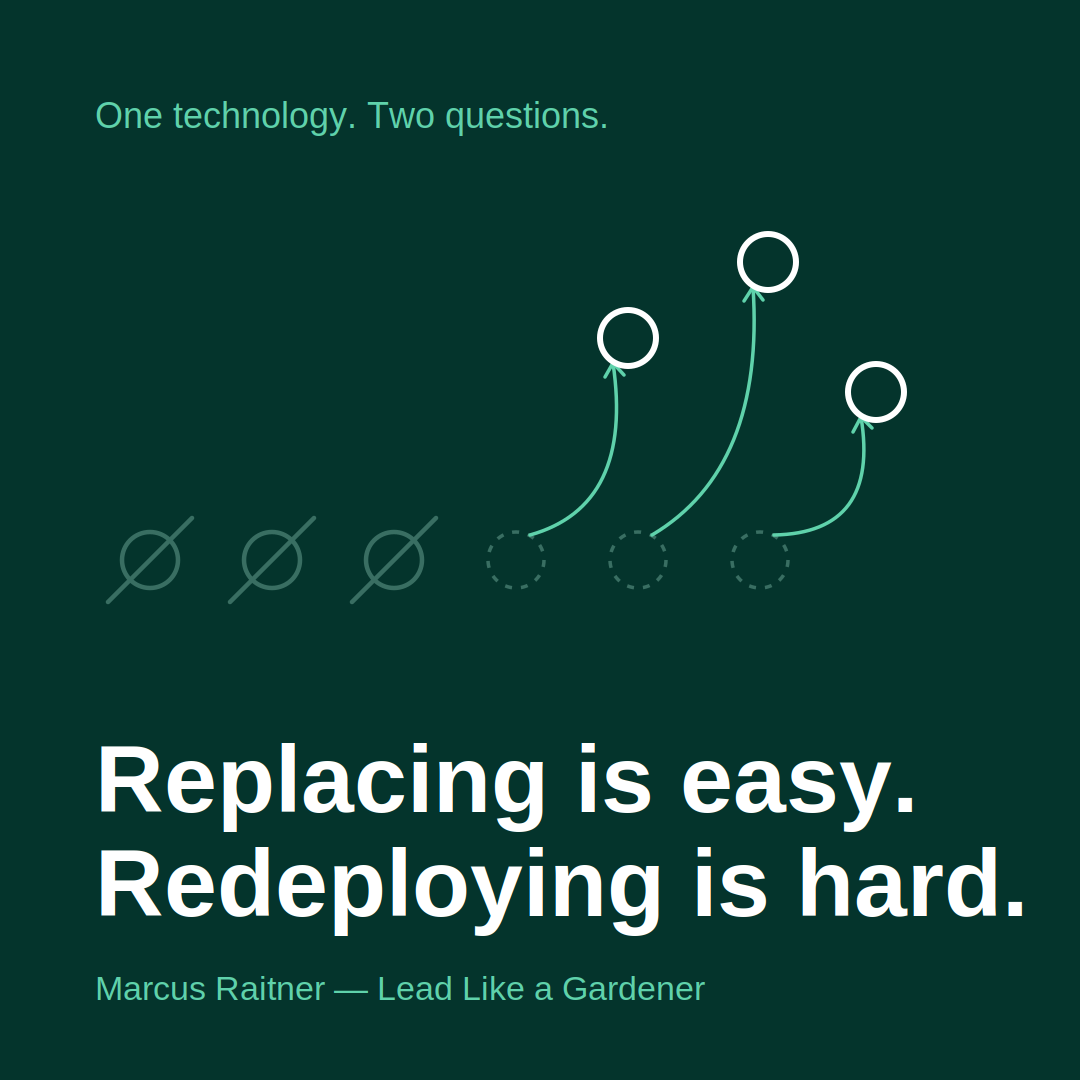
Replace asks what the people cost. Redeploy asks what they could be worth. Klarna answered the first — the question almost any CFO would ask — and answered it competently. IKEA answered the second, and did what this series keeps returning to: it studied the system before reorganizing it. The 53 percent were not noise around the automation; they were the discovery. Automation reveals which work only humans can do — but only if someone looks.
In fairness to Klarna: it fired no one — a hiring freeze and natural attrition did the shrinking — and it rejects the reversal framing: the company still calls itself AI-first, the rehiring began as a pilot with two agents, and its IPO in September 2025 was a success. The honest contrast is not business failure; it is what happened to quality, and to people. Siemiatkowski’s admission deserves respect — admitting a mistake is rarer than making one.
And in fairness to the comparison: IKEA is no fairy tale. In 2026, Ingka and its franchisor Inter IKEA cut roughly 1,650 corporate roles, citing declining sales and organizational complexity, not AI. The point is not sainthood. The point is which question gets asked at the moment automation frees people up.
Nor is Klarna an outlier. Gartner predicts that by 2027, half of companies that attributed headcount reductions to AI will rehire — under different job titles. The replace-and-retreat pattern is becoming its own statistic.
One thing, though, has to be in place before anyone can even find the 53 percent: people who don’t fear that every improvement they surface is their own elimination. That condition has a name, and it is older than most people think — which is where this series goes next.
The technology was identical. The question was not.
Part 4 of the series “Empowering Transformation — Notes on Change That Sticks”. Part 1: “Doing the Wrong Thing Righter”. Part 2: “The Planes Never Landed”. Part 3: “The Electric Motor Fallacy”. Next: why psychological safety is a hard system condition, not a soft skill — and the oldest lesson in operational excellence.
Sources: Klarna press release, February 27, 2024; Bloomberg, “Klarna Slows AI-Driven Job Cuts With Call for Real People,” May 8, 2025; Forbes, May 18, 2025; Ingka Group Newsroom, June 2023; Reuters via PYMNTS, June 14, 2023 (channel revenue and the 10%-by-2028 target); Gartner press release, February 3, 2026; on the 2026 Ingka/Inter IKEA corporate cuts: Employer Branding News, June 12, 2026.